M4 Printing
Two systems: a quotation platform and a configuring webshop.
- Quotation system
- Webshop
- Configurator
- Automation
- Calculation
The challenge
Every request is different — another material, another size, another finish — so the price hung on a series of calculations someone worked out by hand. For as long as that someone had not got round to it, the customer waited.
What we built
For a printing company that produces floors, carpet and walls to measure we built two separate systems: the internal platform their quotations are made in, and the webshop where customers put the job together and order it themselves.
- A configurator that assembles a job in seven steps
- A calculation that moves with every choice, with no button to press
- Numbered quotations the customer accepts or declines online
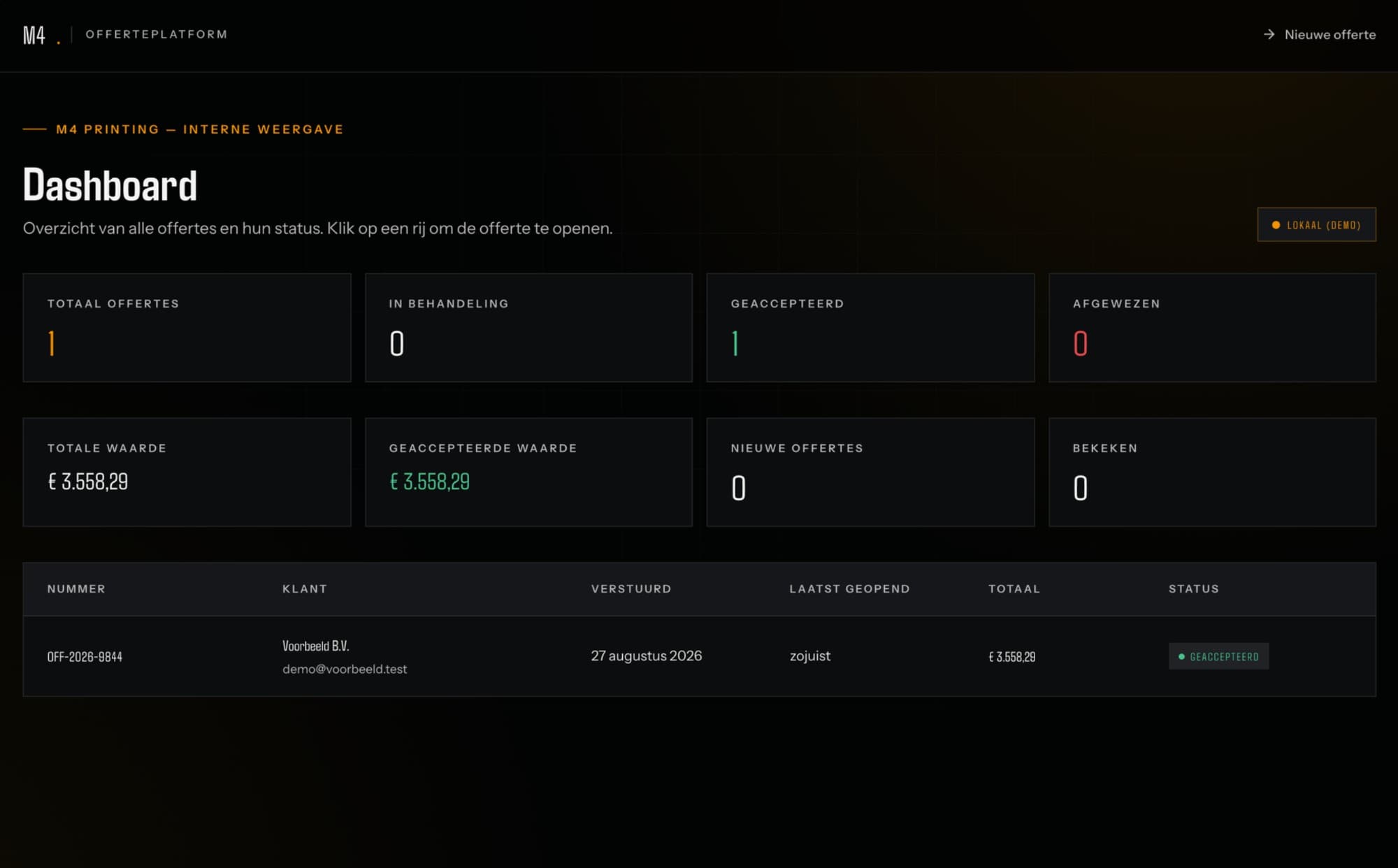
- A dashboard showing what is open, what was accepted and what it is worth
- A webshop that works size out into panels, seams and rolls
- An automatic assessment of the uploaded print file
- Ordering and payment, with one internal dossier per order
The quotation system
For a printing company that produces floors, carpet and walls to measure, we built the system their quotations are made in. Every request is different: another material, another size, another finish, transport or no transport. The price therefore hung on a series of calculations someone worked out by hand, and for as long as that someone had not got round to it, the customer waited.
In the system, the salesperson assembles the job in seven steps: product, material, dimensions, finish, delivery, extras and details. The calculation runs alongside every step. Choose a different material or a different finish and the price breakdown moves with it — material, finish, packaging, transport, surcharges, VAT and total, each visible separately instead of buried in one final figure. There is no 'calculate' button to press.
The system knows the company's rules. Packaging is mandatory and cannot be clicked away. Transport within the Netherlands has its own rate; abroad goes on request. Materials belong to products and only appear where they are technically possible. What an employee first had to get out of a price list and out of experience now sits in the system itself — not as a reference work, but as something that thinks along at the moment the choice is made.
At the end a complete quotation comes out, with its own number and an expiry date: the specifications, the panel layout, an itemised investment table and the terms. The customer receives it by email, opens it in the browser and accepts or declines with one button. Every email that belongs with it — the confirmation, the acceptance, the decline with a reason — goes out automatically in the company's own house style.
Meanwhile the company sees on a single dashboard where everything stands: how many quotations are open, what has been accepted, what value sits behind it, and per quotation when the customer last opened it. That last one turns out to be the most useful in practice. A quotation viewed three times but not accepted is worth a phone call.
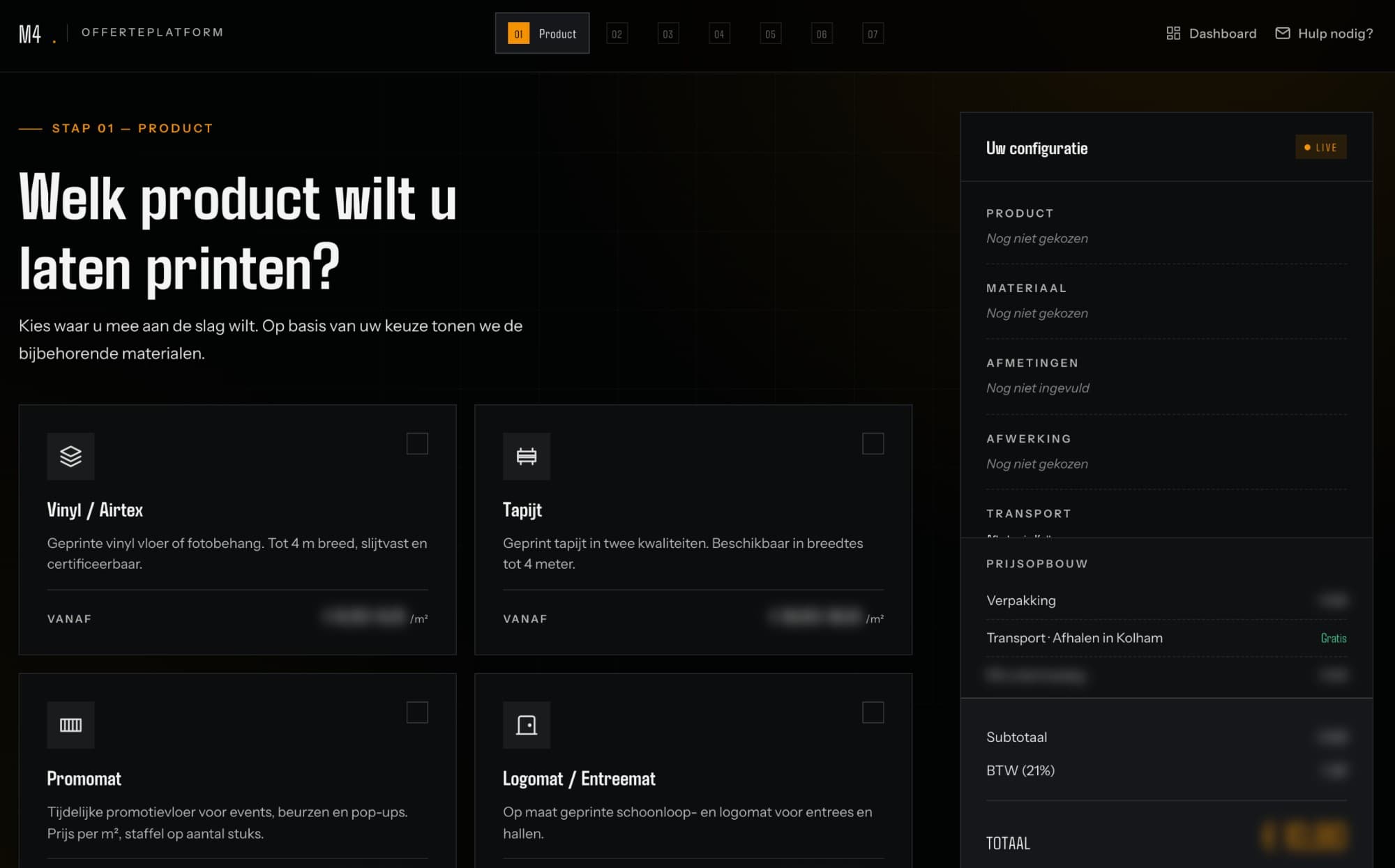
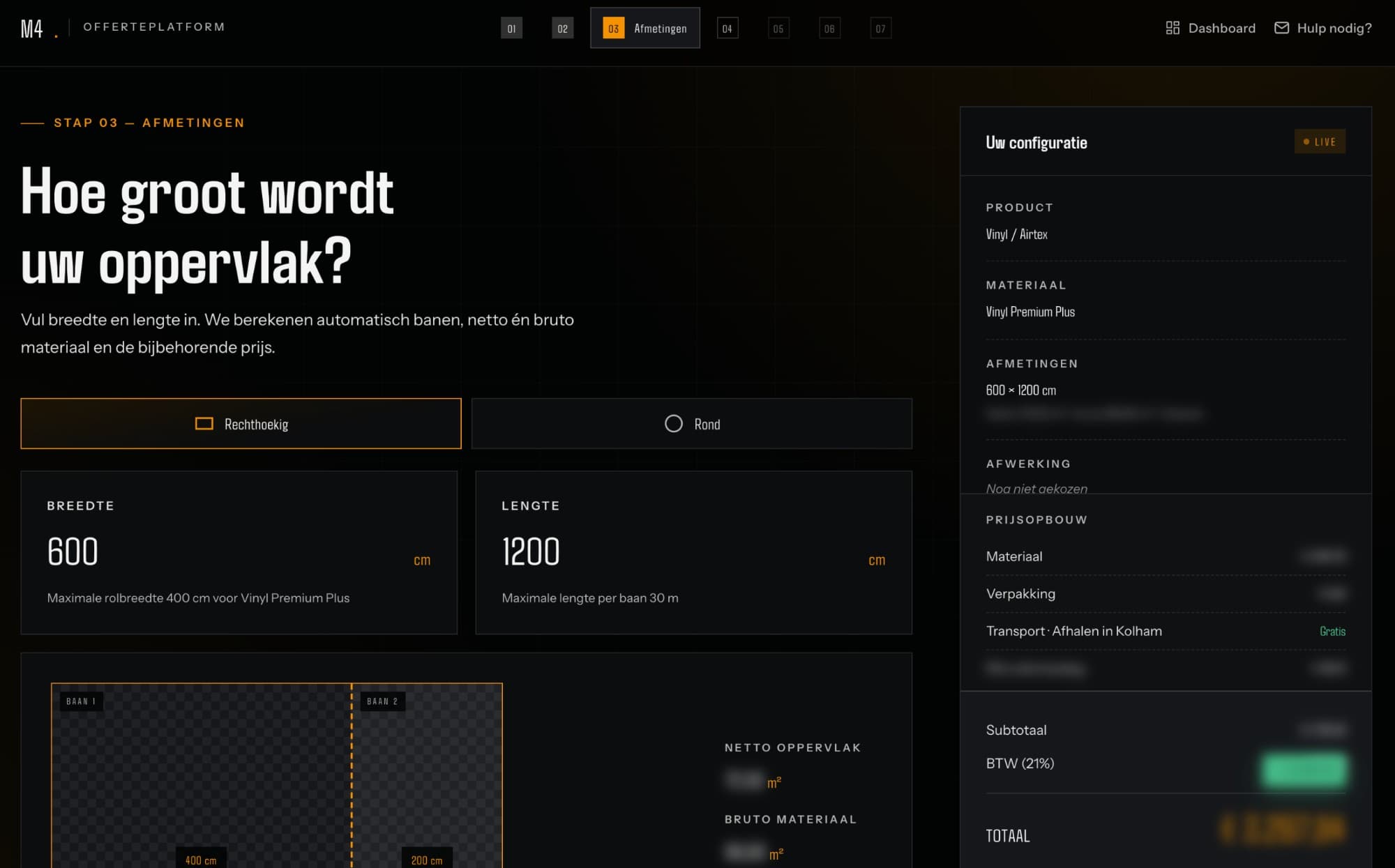
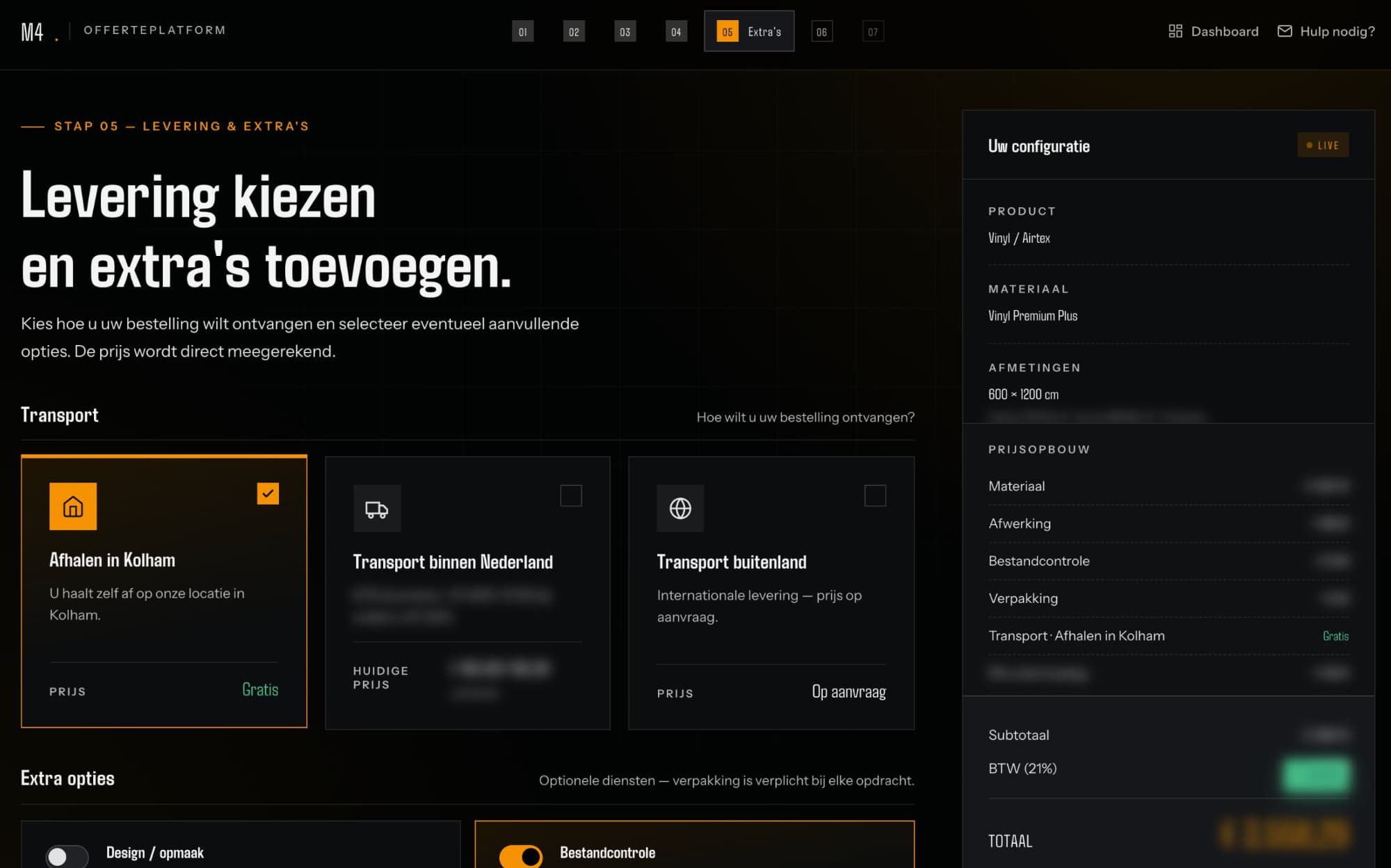
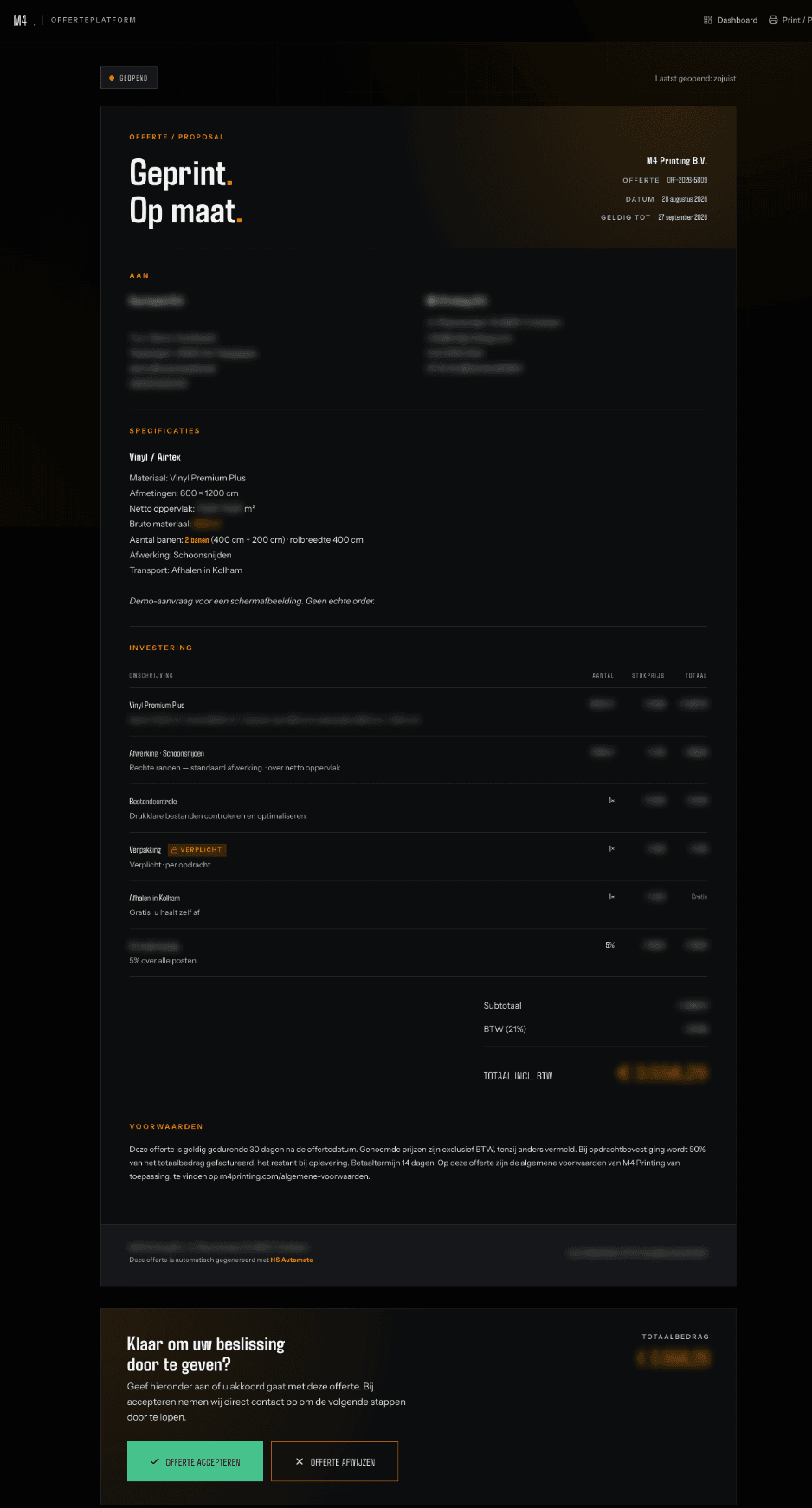
Step 01 — the product is chosen. The configuration panel on the right is already live.
The webshop
For the same printing company we built the webshop where customers assemble their own job and order it directly. Print to measure fits an ordinary webshop badly: the price does not hang on an article but on how the size divides across the material. A floor of six by twelve metres does not fit on one panel — it is produced in strips, and the number of strips, seams and rolls decides what it costs. That sum used to be made by a person, and until it was done the customer could not see a price.
In the webshop the system makes it. The customer enters the measurements and immediately sees how the floor is divided: three panels of four metres, two seams, delivered on three rolls, with a drawing alongside. The system looks for the most economical layout itself — it turns the panels so that as little material as possible comes off the roll, and within that so that as few seams as possible are created. Whether someone enters 600 by 1200 or 1200 by 600 makes no difference; the outcome is the same, because for production it is too.
The webshop also looks at the print file. Straight after upload it measures the image size, the sharpness at the chosen format, the ratio and the colour mode, and reports what is not in order — a file too small for twelve metres of floor is rejected before it goes into production. Just as important is what the system does not do: what it cannot establish reliably, it simply says. A file is never presented as approved when it has not truly been checked. Anyone who wants certainty buys a check by a prepress specialist alongside it.
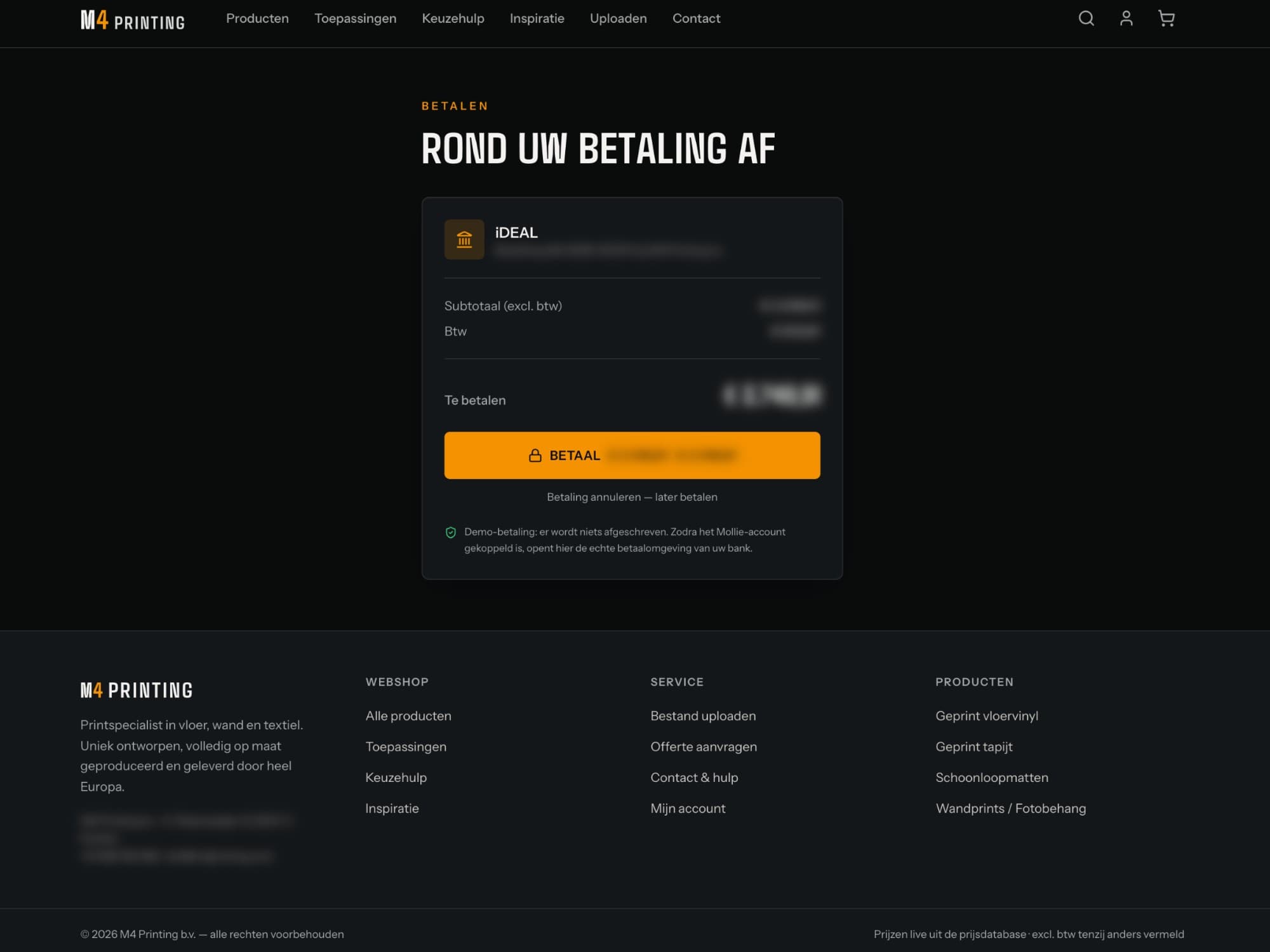
The rest of the order runs the way a customer expects: basket, details, payment page, confirmation. The payment status comes solely from the payment provider and never from a click on 'order'. The moment the order is placed the system records everything once — prices, sizes, panels, lead time — so that a later price change no longer alters an existing order.
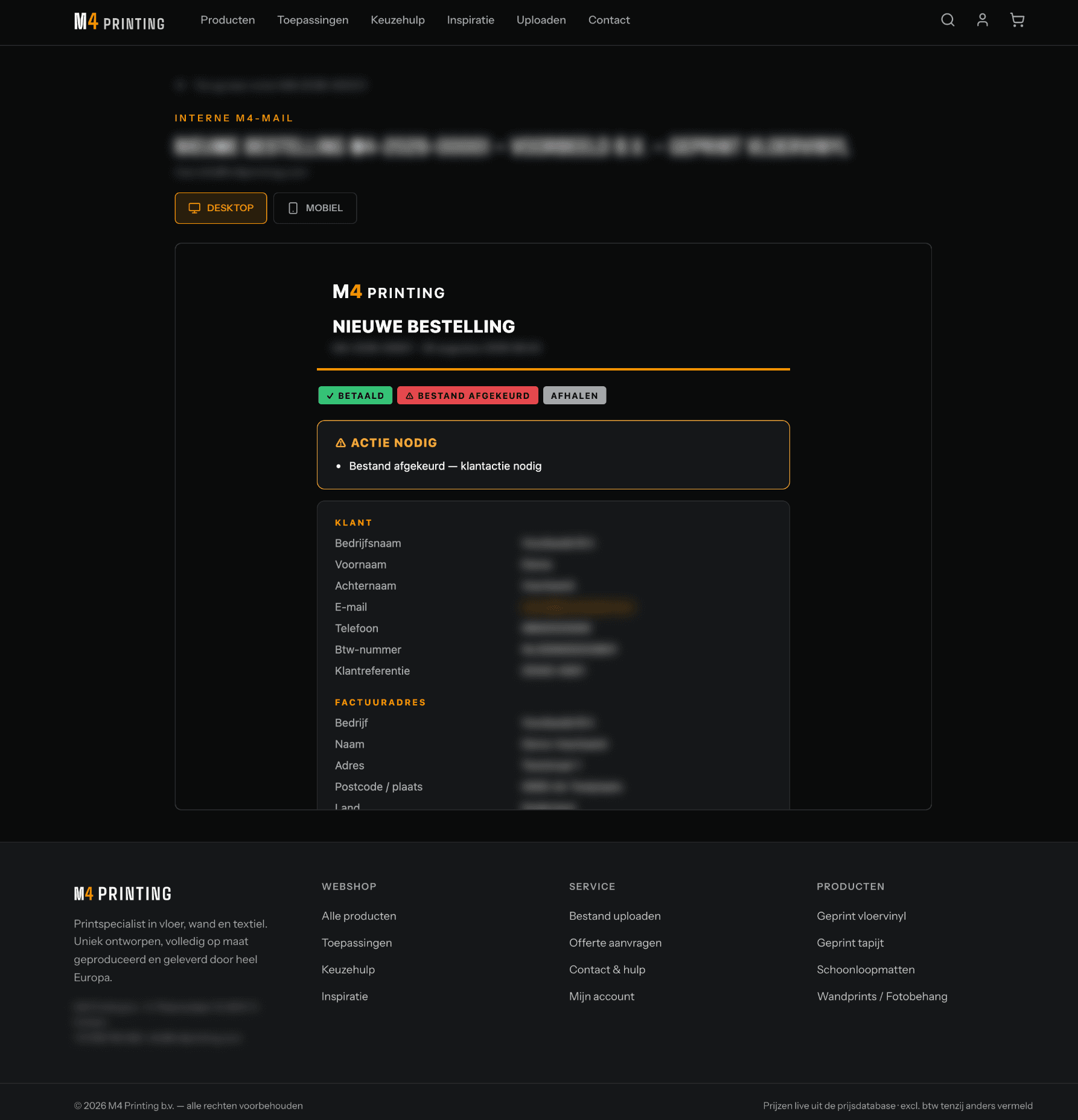
Internally one dossier comes out of it: customer, payment, delivery, the panel layout per panel, the assessed file, the order history and the send log of the emails. Alongside the tidy confirmation for the customer, a second, far more detailed email goes to the shop floor, with the statuses above it: paid, file rejected, collection in Kolham. Whoever picks up the order sees at a glance what has to happen — and where something is still missing.
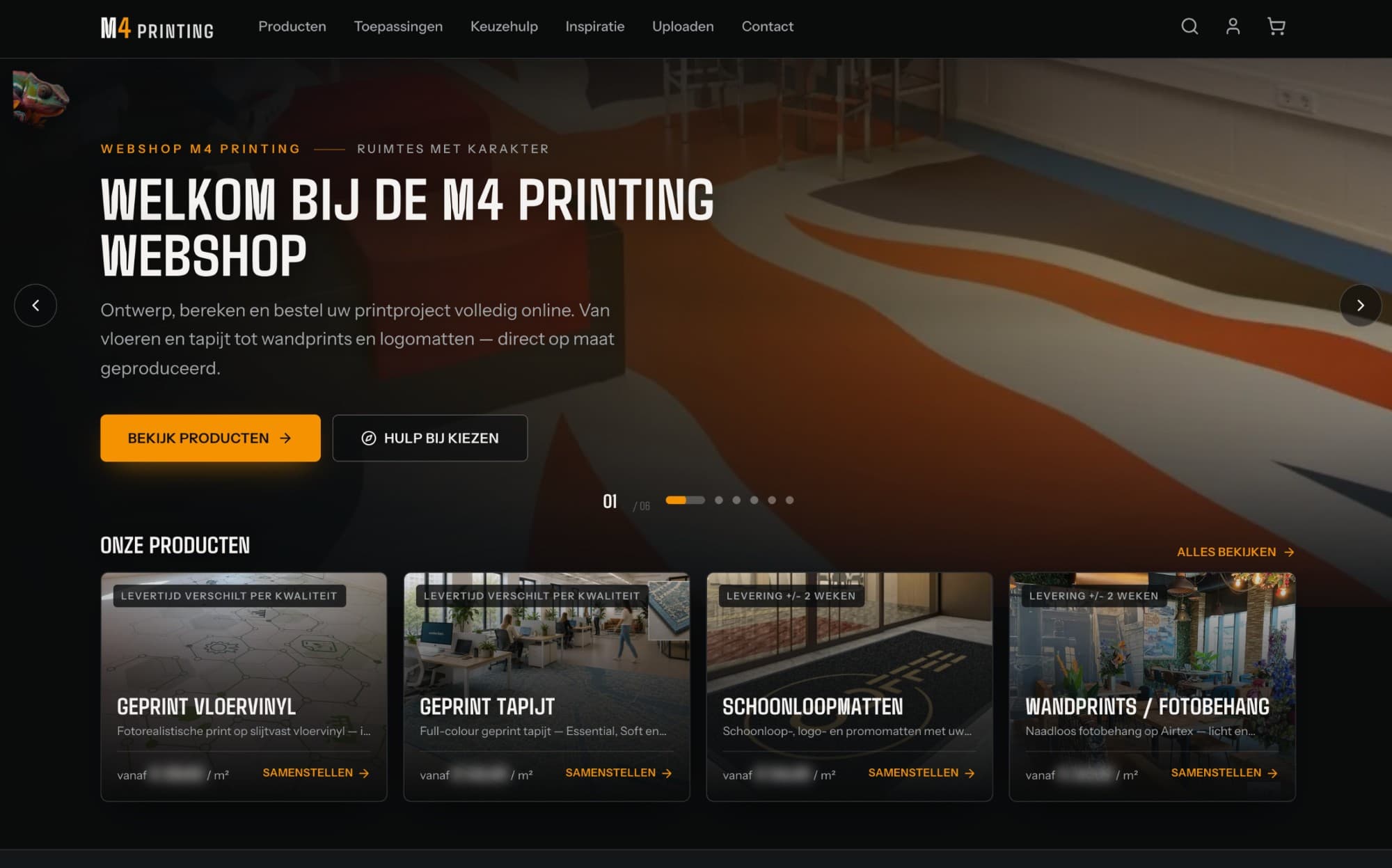
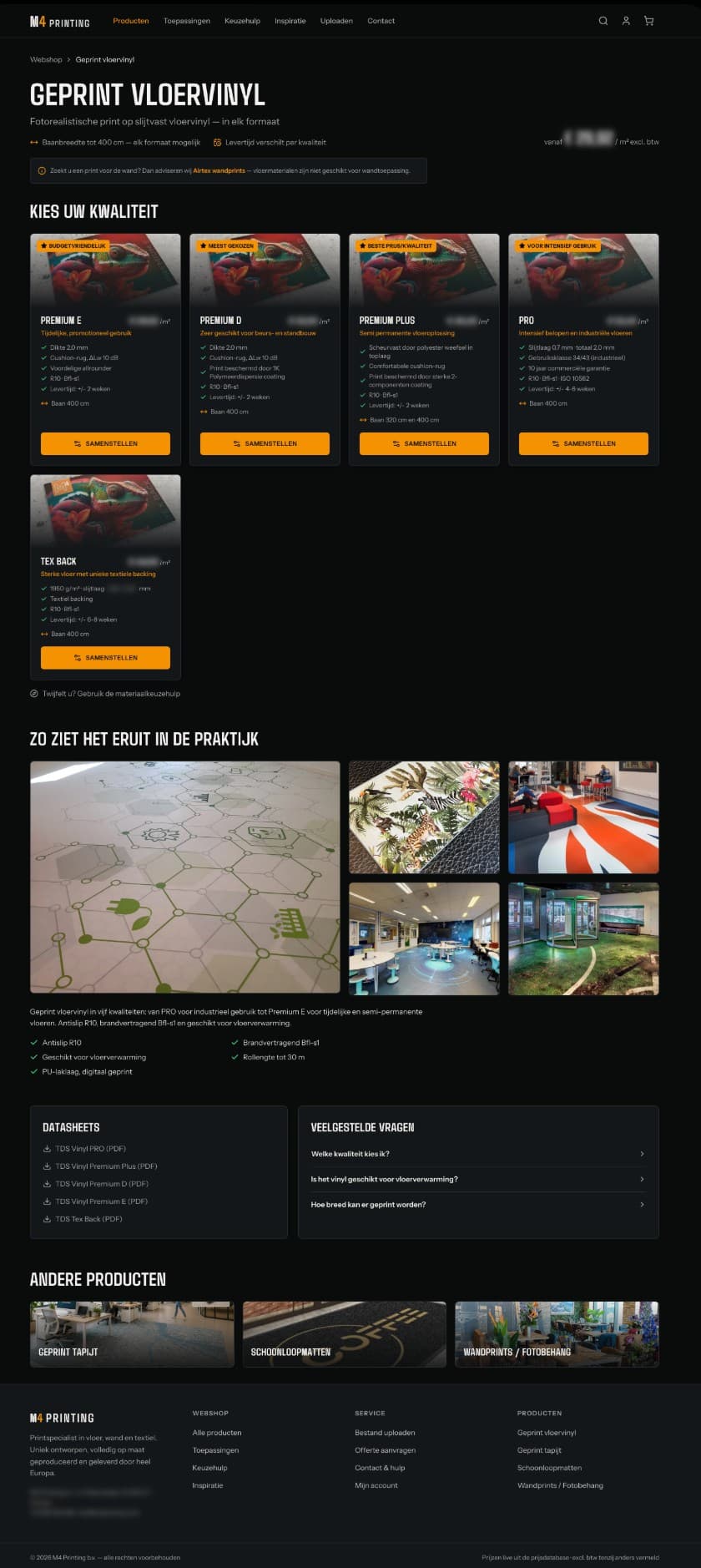
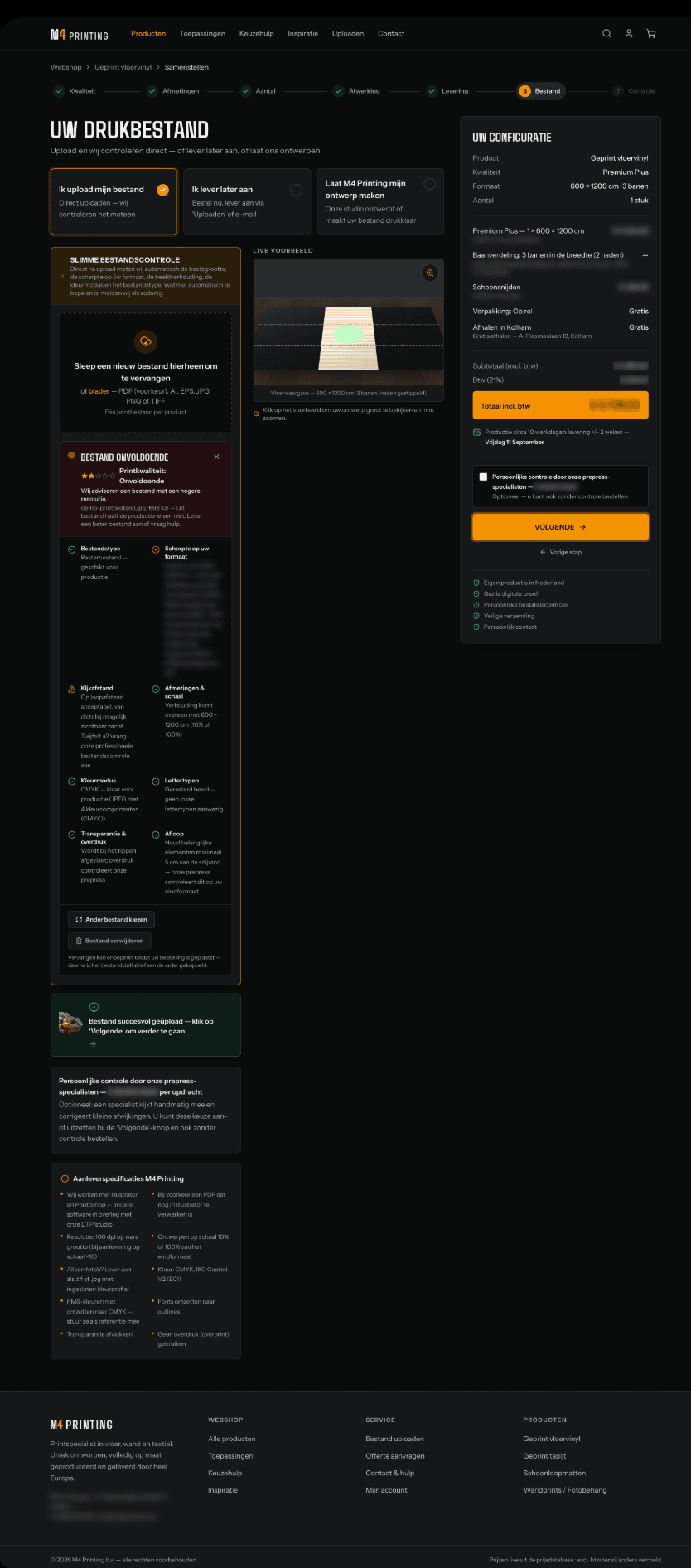
The shop — floors, carpet, mats and wall prints, each configured and priced to measure.
Have something in mind?
Tell us which process is costing you time.